
Live lab
Science, live
Real numbers, right this second. Every calculation runs in your browser, using NASA data and the laws of physics. Found a favorite? Copy its link and send it to a friend.











Live · Your speed
Sitting still? Not even close.
Even in your chair, you're racing through space four different ways at once. Calculated for New York.
The Sun races through the galaxy with all its planets, and Earth circles the moving Sun. So Earth's real path isn't a circle at all: it's a corkscrew. One loop really takes a year; here it takes 20 seconds.
Since you opened this page
0 km
That's how far you've traveled through the galaxy, in just 0s. At this speed, New York to Los Angeles takes about 17 seconds.
One turn every 24 hours. Fastest at the equator, almost zero at the poles.
A 584-million-mile (940-million-km) lap every year. We're closest to the Sun in early January, so we go a bit faster then.
The whole Solar System is on the move. Even so, one lap around the galaxy takes about 230 million years.
Our speed measured against the oldest light in the universe, the cosmic microwave background, which fills all of space.
So why don't we feel it?
Because the speed is perfectly steady, and everything around you (the air, your room, the oceans) is moving with you at the same speed. Your body only feels changes in speed, like when a bus suddenly brakes. Close your eyes on a smooth flight and it feels like you're standing still. Same thing.
The four speeds don't simply add up, because they point in different directions. Each one answers a different question: how fast, compared to what?
 Watch the episodeI Tried to Land on Every Planet
Sources: Earth's spin 465.1 m/s at the equator; orbital speed computed live from Earth's distance to the Sun (astronomy-engine, based on NASA JPL ephemerides); the Sun's galactic speed about 230 km/s and 370 km/s against the cosmic microwave background (ESA Planck (opens in a new tab)).
Live · Moon now
Tonight's Moon
How much of the Moon is lit right now, exactly how far away it is, and when the next full moon arrives. Times shown for New York.
Waxing crescent · 0% lit
0 days since the new moon
Why does the Moon change shape?
Half of the Moon is always lit by the Sun. But as the Moon circles Earth, how much of that sunlit half faces us changes every night. See all of it: full moon. See none of it: new moon. One full cycle takes about29.5 days.
The first thin crescent after a new moon shows up low in the west just after sunset, usually one or two evenings later if the sky is clear.
Why does the distance change?
The Moon's orbit isn't a perfect circle; it's slightly stretched. So every month the Moon swings about31,000 miles (50,000 km) closer, then drifts away again. A full moon at the close end is what people call a "supermoon".
Calculated in your browser with astronomy-engine (accurate to about a minute for phases and rise/set times), based on NASA JPL ephemerides. Distance is center of Earth to center of the Moon.
Live · Day & night
Where it's day and night, right now
The line between day and night is drawn from the real Sun's position this minute. Right under the yellow dot, the Sun is straight overhead.
Why is the line curved, and why does it swing?
Earth is tilted 23.4° on its axis. In June the Northern Hemisphere leans toward the Sun: long days, more heat. In December it's the other way around. Press "Play a year" and watch the line rock back and forth like a pendulum. In March and September it stands straight up, and on those two days, day and night are almost equal everywhere on Earth.
How fast does the line move?
About 1,040 mph (1,670 km/h) at the equator, and about 790 mph (1,270 km/h) at New York's latitude. That's faster than a passenger jet: sunrise races across the planet from east to west. It reaches Maine about three and a half hours before it reaches California.
Sun position from astronomy-engine (NASA JPL based). Map imagery: NASA Blue Marble and Black Marble. Sunrise and sunset are for the top edge of the Sun at sea level, as in almanacs.
Live · Light delay
Even light takes time
Light covers 186,000 miles (300,000 km) every second, the fastest anything can go. But space is so big that light still takes minutes, hours, even years. Send a pulse and watch.
Pulse sent 0s ago · light has gone 0 km
Looking up means looking back in time
The Sun you see is the Sun from 8 minutes ago: that's how long its light takes to get here. Even the light reaching your eyes tonight from the nearest star left it more than four years ago.
Why can't NASA drive a Mars rover with a joystick?
A command takes … to reach Mars today, and the reply takes just as long to come back. So NASA's rovers aren't driven live. Engineers send a whole day's to-do list at once, and the rover finds its own way.
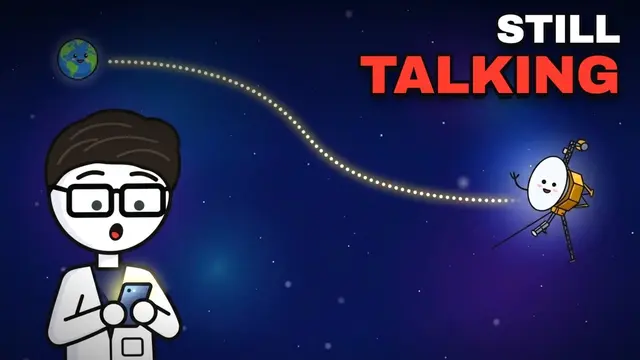 Watch the episodeNASA's Voyager 1 Is Still Talking to Us After 49 Years
Distances for today from astronomy-engine (NASA JPL based) and, for Voyager 1, NASA JPL Horizons. Proxima Centauri: 4.2465 light-years. Speed of light: 299,792.458 km/s, exact.
Live · Space station
Where's the space station?
The International Space Station is humanity's home in orbit. Astronauts live, work and sleep up there right now. Here's exactly where it's flying this second.
ISS data is taking a moment. Please try again shortly.
Next pass over New York
Calculating…
ISS distance from you, now
… km
Why doesn't the ISS fall down?
It does! It's falling toward Earth every single moment. But it's also flying sideways so fast (about5 miles, or 7.7 km, every second) that Earth's curved surface drops away just as fast as it falls. So it keeps falling around the planet instead of into it. That's what an orbit is.
Can you see it with your own eyes?
Yes: it looks like one of the brightest "stars" in the sky, gliding across without blinking. But only just after sunset or before sunrise, when your sky is dark but the Sun still shines on the ISS high above. The astronauts see about 16 sunrises every day.
Orbit: latest NORAD two-line elements from CelesTrak (opens in a new tab), refreshed every two hours; positions computed in your browser with SGP4 (satellite.js). Passes are listed when the ISS climbs at least 10° above the horizon.
Live · Cosmic age
Your cosmic age
Enter your birth date. It stays in this browser only: it's never sent anywhere, and it's not in the link you copy.
Trips around the Sun
0
Every birthday means Earth has carried you once all the way around the Sun. On those laps you've traveled 0 km, plus another 0 km riding with the Sun through the galaxy.
The light that left Earth on the day you were born is now 0 light-years away. It has already passed 0 stars.
Your age on other planets
Why is your age different on other planets?
"One year" just means one trip around the Sun. Mercury is so close to the Sun that it makes a lap in only 88 days, so there you'd be more than four times older. Saturn is so far out that one lap takes about 29½ years: you might not have had your first birthday there yet.
What's a light-year?
The distance light travels in one year: about 5.9 trillion miles (9.5 trillion km). So however many years old you are, the light from your birthday is that many light-years away. At 25, it passes the star Vega.
 Watch the episodeAre We Aliens? The Evidence Is Stranger Than You Think
Star distances: NASA and the European Space Agency's Gaia mission (rounded). Orbital periods: NASA planetary fact sheets. Your date never leaves this browser.
Live · Earth now
Right now, on Earth
What happens on our planet every second. "Today" counts from midnight in New York.
About 4 every second
About 2 every second
Births minus deaths
About 44 every second
About 16 million tonnes of water every second
Picked up by instruments: about one a minute
Sunlight reaching Earth since you opened this page
0 terajoules
That's as much energy as all of humanity uses in 0 days. In about one hour, the Sun sends Earth as much energy as people use in a whole year.
Are these real counts?
Not one by one: they're yearly totals divided into seconds. About 130 million babies are born each year, so on average that's about 4 every second. Any single moment can run a little higher or lower, but over a whole day the total lands very close.
Where does lightning strike most?
About 90% of lightning happens over land, mostly in hot, humid places: Central Africa, South America and Southeast Asia. In the US, Florida gets the most. When thunder roars, go indoors and stay away from open fields and water.
 Watch the episodeWhat If You Drilled Straight Through the Earth?
Rates from yearly totals: births and deaths, UN World Population Prospects (opens in a new tab); lightning about 44 flashes a second, from NASA satellite counts; precipitation about 500,000 km³ a year; earthquakes about 500,000 detected a year, USGS (opens in a new tab); sunlight 173,000 terawatts at the top of the atmosphere; world energy use about 620 exajoules a year (Energy Institute Statistical Review). Lightning positions on the map are illustrative, weighted to land and the tropics.