
NASA's Voyager 1 Is Still Talking to Us After 49 Years
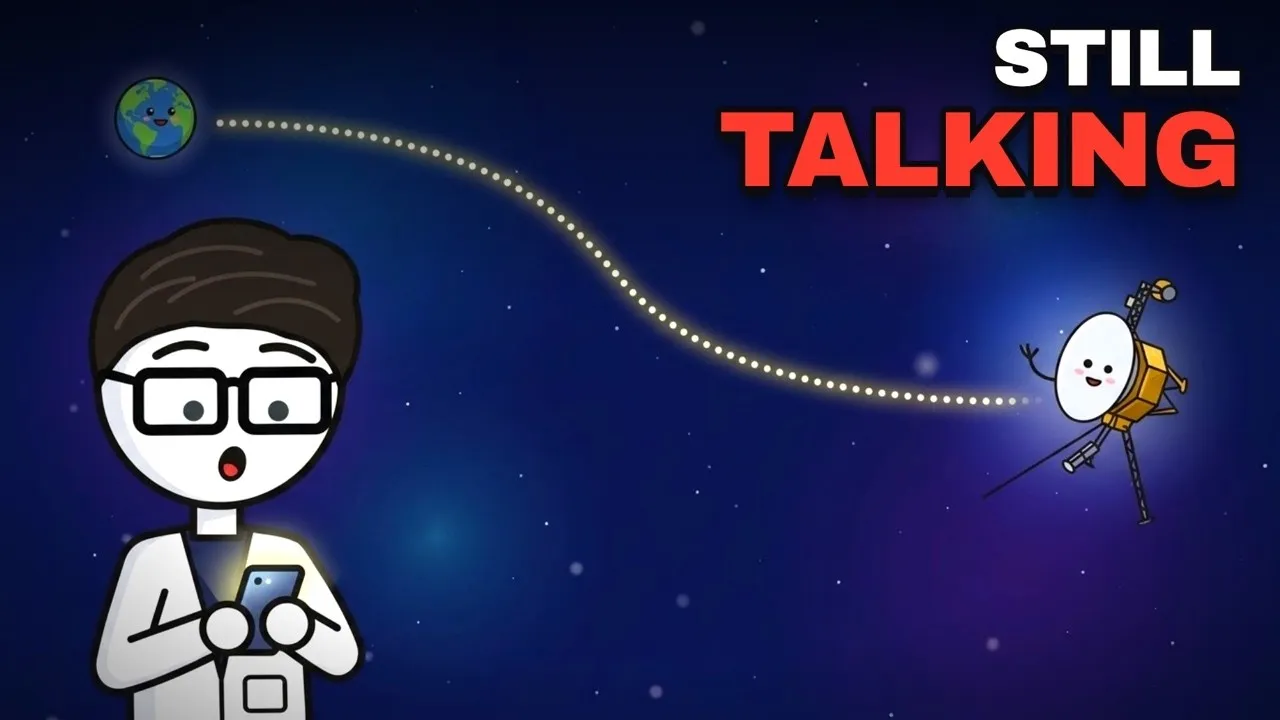
Imagine saying "hello" and waiting a whole day for it to arrive. On November 18, 2026, that's exactly how far away Voyager 1 will be: one light-day from Earth. Launched in 1977 with less memory than one photo on your phone, it flew past Jupiter and Saturn, took the Pale Blue Dot, left the Sun's bubble, and survived a breakdown that NASA fixed from 15 billion miles away. Join Dr. PX for the whole story, with the real NASA photos.
Chapters
- 0:00 A phone call that takes a whole day (opens in a new tab)
- 0:57 1977: a lucky line-up and a launch (opens in a new tab)
- 1:42 Jupiter, Io and Saturn (opens in a new tab)
- 2:00 The Pale Blue Dot (opens in a new tab)
- 2:24 Popping out of the Sun's bubble (opens in a new tab)
- 2:48 Has it left the Solar System? (opens in a new tab)
- 3:13 The Golden Record (opens in a new tab)
- 3:38 2023: Voyager talks gibberish (opens in a new tab)
- 4:36 Nov. 18, 2026: one light-day (opens in a new tab)
- 5:04 Getting tired (opens in a new tab)
- 5:46 Your turn (opens in a new tab)
Sources
- Launch, flybys, the 175-year line-up, power and instruments: NASA Voyager mission pages and FAQ
- One light-day on Nov. 18, 2026: NASA via EarthSky
- Interstellar space (2012): NASA/JPL
- The Oort Cloud (300 / 30,000 years): NASA Science
- The 2023–2024 rescue: NASA/JPL
- Golden Record contents: NASA Science
- Transmitter about as strong as a fridge bulb: NASA/JPL (PIA17047)
- Volcanoes on Io: NASA Science
- Passing another star in about 40,000 years: NASA Photojournal
Spotted a mistake or have a question? Ask Dr. PX
Credits
Photos: NASA/JPL (public domain), via Wikimedia Commons. Music: YouTube Audio Library. Sound effects: original. Narration: AI-generated voice.