
I Tried to Land on Every Planet
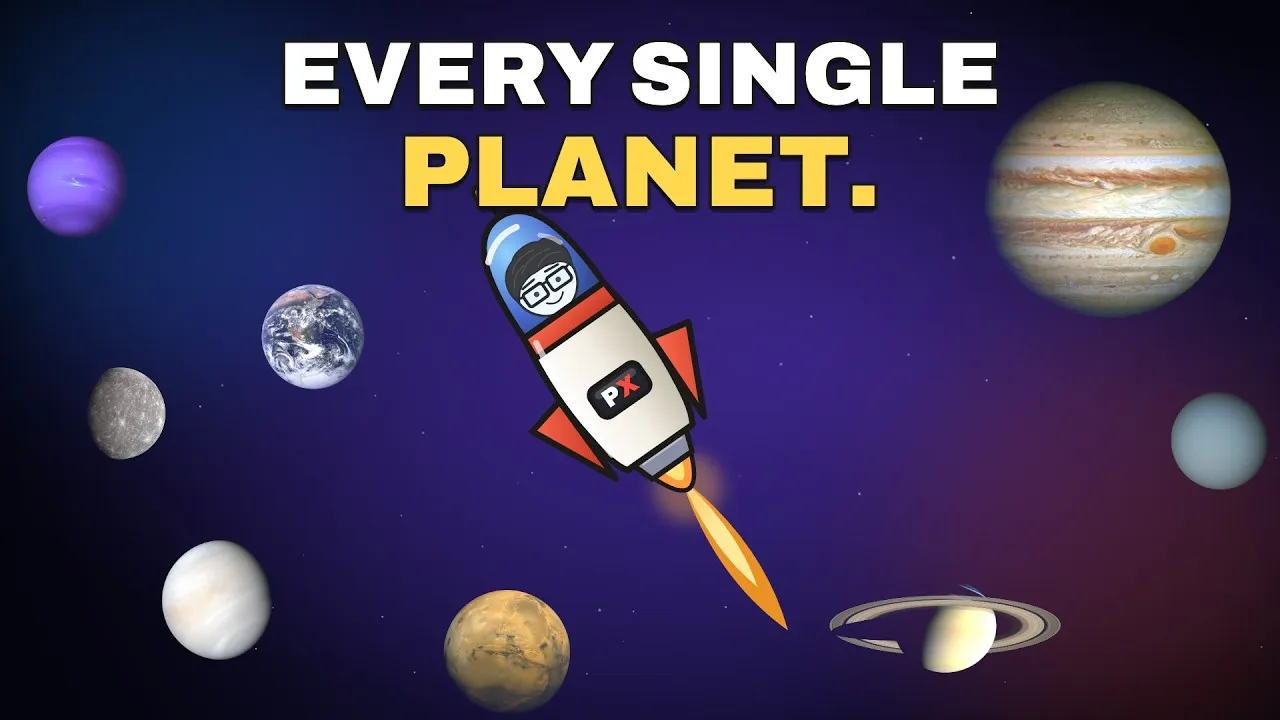
Eight planets. One rocket. One very official passport. Dr. PX tries to land on every planet in the solar system and get a stamp from each one: Mercury, Venus, Mars, Jupiter, Saturn, Uranus and Neptune (and a quick hello to Pluto). Some of them try to kill him. Four of them don't even have a floor.
You'll see: why the Sun looks 3x bigger from Mercury, the Soviet lander that survived 127 minutes on Venus, Olympus Mons, Mars's blue sunsets, the NASA probe that fell into Jupiter, Saturn's super-thin rings, the planet that rolls on its side, the planet found with math, and why Earth is named after the ground.
Honest note: the trip is a cartoon adventure; every fact in it is real and sourced below. "Diamond rain" on Neptune is a scientific idea, not yet proven.
Chapters
- 0:00 A secret lab, 8 planets, 1 passport (opens in a new tab)
- 0:30 Mercury: touchdown! (opens in a new tab)
- 1:15 Ice on Mercury?! (opens in a new tab)
- 1:30 Venus, the evil twin (opens in a new tab)
- 2:03 Venera 13: 127 minutes on Venus (opens in a new tab)
- 2:40 Mars: 3 for 3 (opens in a new tab)
- 3:17 Blue sunsets and thin air (opens in a new tab)
- 4:01 Jupiter: no floor (opens in a new tab)
- 4:26 The Galileo probe (opens in a new tab)
- 4:58 Saturn's rings (opens in a new tab)
- 5:25 Cassini's final dives (opens in a new tab)
- 5:44 Uranus: rolling on its side (opens in a new tab)
- 6:30 Neptune: 2,000 km/h winds (opens in a new tab)
- 6:49 Found with math (opens in a new tab)
- 7:14 Diamond rain? (opens in a new tab)
- 7:25 Sorry, Pluto (opens in a new tab)
- 7:35 Counting the stamps (opens in a new tab)
- 7:57 Touchdown: Earth (opens in a new tab)
- 8:26 The best planet (opens in a new tab)
Sources
- Planet facts (temperatures, day and year lengths, gravity, winds, tilt): NASA Science planet pages (science.nasa.gov)
- Mercury's polar ice (MESSENGER): NASA
- Venera 13 (1 March 1982, 127 minutes on the surface): NASA NSSDCA
- Mars blue sunset (Curiosity, 15 April 2015) and the 2018 global dust storm: NASA/JPL
- Galileo probe into Jupiter (7 December 1995, ~150 km, ~58 minutes): NASA/JPL
- Saturn's rings (~10 m thick in many places) and Cassini's Grand Finale (2017): NASA
- Uranus discovered 1781 (William Herschel); hydrogen sulfide in its clouds: Irwin et al., Nature Astronomy (2018)
- Neptune predicted by Urbain Le Verrier and found by Johann Galle on 23 September 1846; first orbit since discovery completed in 2011: NASA
- Pluto reclassified as a dwarf planet: IAU (2006)
Spotted a mistake or have a question? Ask Dr. PX
Credits
Animation: PXReality. Music: YouTube Audio Library. Sound effects: original. Narration: AI-generated voice.