
I Spent One Day on Mars
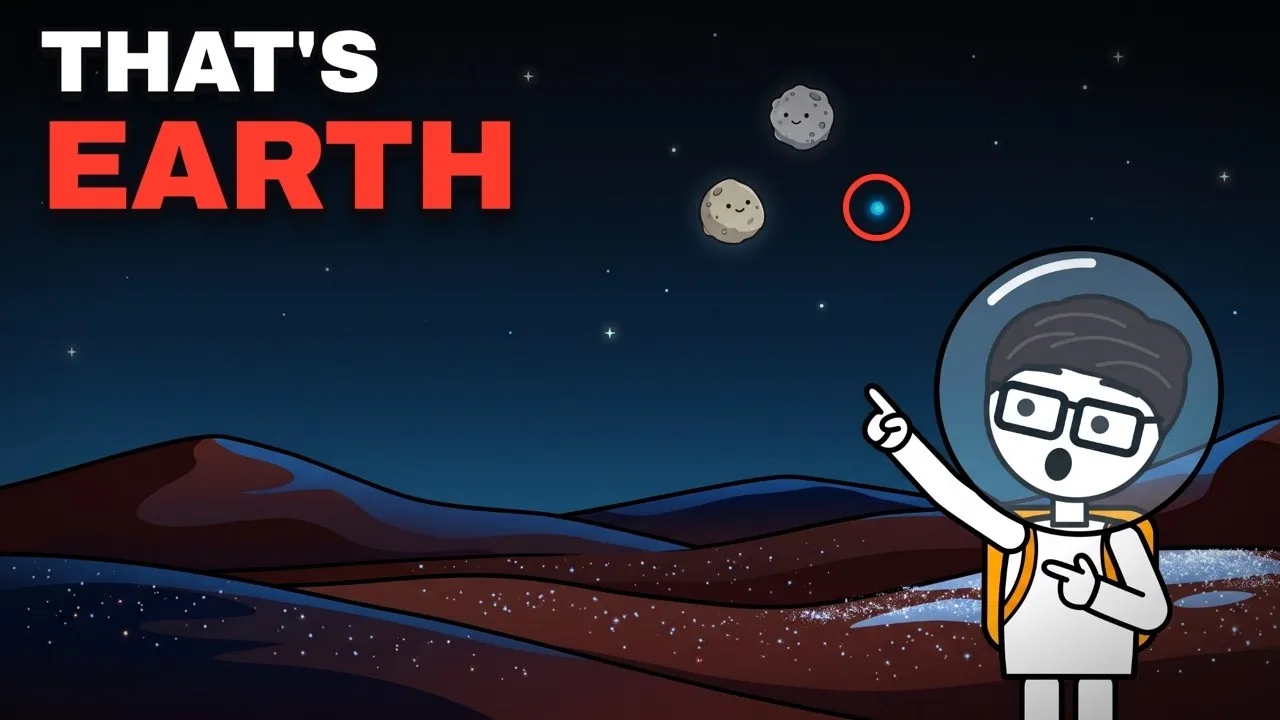
Rule number one on Mars: never take off your helmet. Dr. PX lands before dawn and stays for one full Martian day, from sunrise to sunrise. Minus 70 degrees, a smaller Sun, a dusty orange sky, jumps three times higher, warm feet and a cold head, a real dust devil recorded by NASA's Perseverance rover, the storm that silenced Opportunity, a BLUE sunset, two moons, and Earth as a tiny dot in the Martian night sky.
Chapters
- 0:00 Rule number one on Mars (opens in a new tab)
- 0:50 Sunrise: a smaller Sun (opens in a new tab)
- 1:19 Jumping in low gravity (opens in a new tab)
- 1:40 Noon: warm feet, cold head (opens in a new tab)
- 2:11 What Mars sounds like (opens in a new tab)
- 2:40 A dust devil (real NASA recording) (opens in a new tab)
- 4:02 The storm that ended Opportunity (opens in a new tab)
- 4:48 A blue sunset (opens in a new tab)
- 5:16 Two moons and a potato eclipse (opens in a new tab)
- 5:40 Earth from Mars (opens in a new tab)
- 6:03 Why a day on Mars is longer (opens in a new tab)
Sources
- A Mars day (sol) is 24 h 39 min 35 s; gravity 38% of Earth's; air about 1% as thick, 95% carbon dioxide: NASA Mars facts
- Air temperature in Gale Crater from about -2 °C to -75 °C in one day: NASA/JPL, Curiosity REMS
- The Sun looks about two thirds as big from Mars: NASA (Spirit sunset, 2005)
- Shoes about 10 degrees warmer than your belt at midday: Mars Pathfinder weather mast (Caltech Engineering & Science, 1997)
- Sound on Mars is about 20 dB quieter, with two speeds of sound (about 240 and 250 m/s): Maurice et al., Nature 605 (2022); NASA/JPL
- Dust devil recorded passing over Perseverance, Sept 27, 2021 (about 118 m tall, 308 dust impacts): Murdoch et al., Nature Communications 13 (2022); NASA PIA25657
- Spirit's solar panels cleaned on sol 420 (March 9, 2005): NASA/JPL
- Opportunity: planned for 90 days, last contact June 10, 2018, more than 1,000 recovery commands, mission ended Feb 13, 2019: NASA/JPL
- Blue sunset in Gale Crater, April 15, 2015: NASA/JPL-Caltech/MSSS/Texas A&M, PIA19400
- Phobos rises in the west and sets in the east about twice a day: The Planetary Society
- Phobos crossing the Sun, April 2, 2022: NASA/JPL-Caltech/ASU/MSSS/SSI, PIA25179
- Earth and the Moon from Mars, Jan 31, 2014: NASA/JPL-Caltech/MSSS/TAMU, PIA17935 and PIA17936
- Living on Mars time ("like traveling two time zones every three days", Laura Barger, Harvard Medical School): Space.com (2008)
Spotted a mistake or have a question? Ask Dr. PX
Credits
Real recording: Mars dust devil, NASA/JPL-Caltech/LANL/CNES/CNRS/INTA-CSIC/Space Science Institute/ISAE-Supaero. Real video: Phobos eclipse, NASA/JPL-Caltech/ASU/MSSS/SSI. Photos: NASA/JPL-Caltech (Curiosity, Perseverance, Opportunity, Spirit, Mars Pathfinder), NASA/JPL-Caltech/Univ. of Arizona (Phobos, HiRISE), NASA/JPL-Caltech/MSSS (Mars before and during the 2018 storm). Music: YouTube Audio Library. Sound effects: original. Narration: AI-generated voice.